
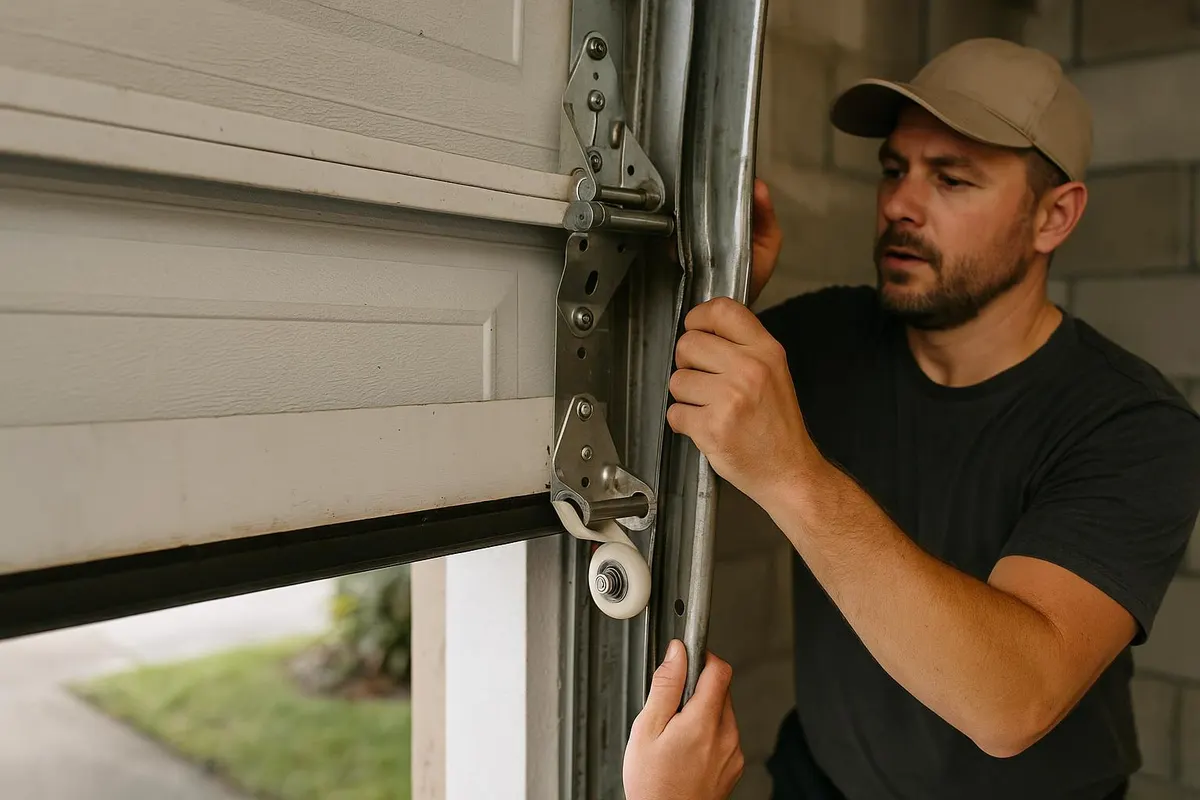
Frozen Shut: Why Your Choctaw Garage Door Won't Budge on a Cold Morning
The first cold snap of the season hits, you hit the remote, and the door either doesn't move or groans halfway up and stops. The instinct almost everyone has is to hit the button again, then again, then walk over and pull or push on the door by hand to "help it along." It's tempting because it sometimes works — a hard yank breaks a thin ice seal loose, or a second try on the opener gets past whatever was sticking. But repeated forcing is exactly how a sluggish cold-weather door turns into an expensive one. A motor that keeps trying against resistance can strip its internal gear. A door yanked free of ice can bend a panel or pop a cable off its drum. If the door is fighting you, the smarter move is to figure out why before you add more force.
What You'll Notice First
Cold-weather garage door trouble tends to show up as one of these:
- The door looks stuck right at the bottom, like it's glued to the slab, even though the opener motor is clearly running.
- The opener runs but the door only lifts an inch or two before reversing or stopping.
- The door moves, but noticeably slower and noisier than normal, with more shaking in the track.
- The door feels heavy if you try to lift it manually, heavier than it does in warm weather.
- The opener clicks or hums but nothing happens at all.
Each of these points toward a different cause, and in a Choctaw winter — where a hard freeze can follow a 60-degree afternoon within a day — more than one of these can show up at once.
Working Through the Causes, in the Order a Technician Checks Them
1. The bottom seal frozen to the slab
This is the first thing to rule out because it's the most common and the easiest to fix. If rain or melted frost got under the door overnight and the temperature dropped, the rubber weatherstripping along the bottom can freeze directly to the concrete. The door looks stuck because, for a moment, it is. A tech checks this with a visual inspection and a gentle test push from the inside — if the bottom edge is iced down but the rest of the door moves freely once that bond breaks, that's the whole problem. The fix is simple: break the ice with a gentle flat tool like a putty knife worked along the seam, never with a crowbar or by forcing the opener, then dry the slab and seal area so it doesn't refreeze that night. Cracked or flattened weatherstripping is worth replacing while you're at it, since brittle rubber from a hot Oklahoma summer is more prone to this in the first place.
2. Opener force settings and safety sensors
If the seal isn't the issue, the opener itself is next. Cold air is denser and a door with any added stiffness in the track takes more effort to lift, which can trip the opener's built-in force sensitivity settings — the same feature that makes the door reverse if it senses something in the way. A door that goes up a few inches and reverses, or stops and goes back down, is often an opener reading extra resistance as an obstruction rather than cold. Low temperatures can also affect the photo-eye sensors near the bottom of the tracks; moisture or frost on the lenses can block the beam and stop the door from closing at all. A technician checks sensor alignment and cleans the lenses first, then tests and adjusts the up-force and down-force settings if the door is genuinely working harder than it should.
3. Torsion and extension springs losing tension in the cold
Metal contracts slightly in cold weather, and torsion springs can lose a small amount of lift power as a result — enough that a door riding the edge of correct spring balance in summer becomes noticeably heavier and harder to lift in a hard freeze. This shows up as a door that feels heavy by hand, or an opener straining audibly to lift it. Springs are high-tension components under load even when the door is closed, so this is not a DIY adjustment — a tech checks the balance by disconnecting the opener and testing how the door holds position partway open, then adjusts or replaces the springs if they're under-tensioned or simply worn out.
4. Track and roller lubrication thickening
Lubricant that moves freely in July can thicken in a cold snap, especially on older rollers and tracks that haven't been serviced recently. This produces the slow, noisy, shaky movement rather than a dead stop — the door moves, but it's working against stiff rollers and gummed-up track rather than rolling smoothly. The fix is a proper cleaning of the tracks and a light application of a garage-door-specific lubricant rated for a range of temperatures, not household oil or WD-40, which attracts dust and grit and makes the problem worse over time.
5. Opener motor and gearbox wear
If everything above checks out and the door still won't move, or the opener runs with no result, the issue is likely inside the opener itself — a worn gear, a weak capacitor, or a motor that's been quietly struggling for a while and finally gave out under the extra cold-weather load. This is usually the last thing checked because it's the most involved to diagnose and the most costly to fix, but it's also the most common outcome of a door that's been forced repeatedly while people tried to push past the earlier symptoms.
When to Call Choctaw Garage Door
If breaking the ice loose doesn't solve it, or the door is heavy, noisy, or reversing on its own, it's time to call rather than keep testing it by hand. Choctaw Garage Door can check spring balance and handle spring replacement safely, since it's not a job to take on with a door under tension in freezing temps. If the opener is the culprit, their opener repair and installation service covers everything from sensor alignment to a full replacement if the motor's worn out. A quick seasonal check now, before the next hard freeze, catches most of this before it strands you with the door stuck halfway.
Give Choctaw Garage Door a call if your door is fighting the cold — we serve Choctaw, Midwest City, Del City, Nicoma Park, Harrah, Jones, Luther, and Spencer, and we'll get it moving right before winter settles in for good.