
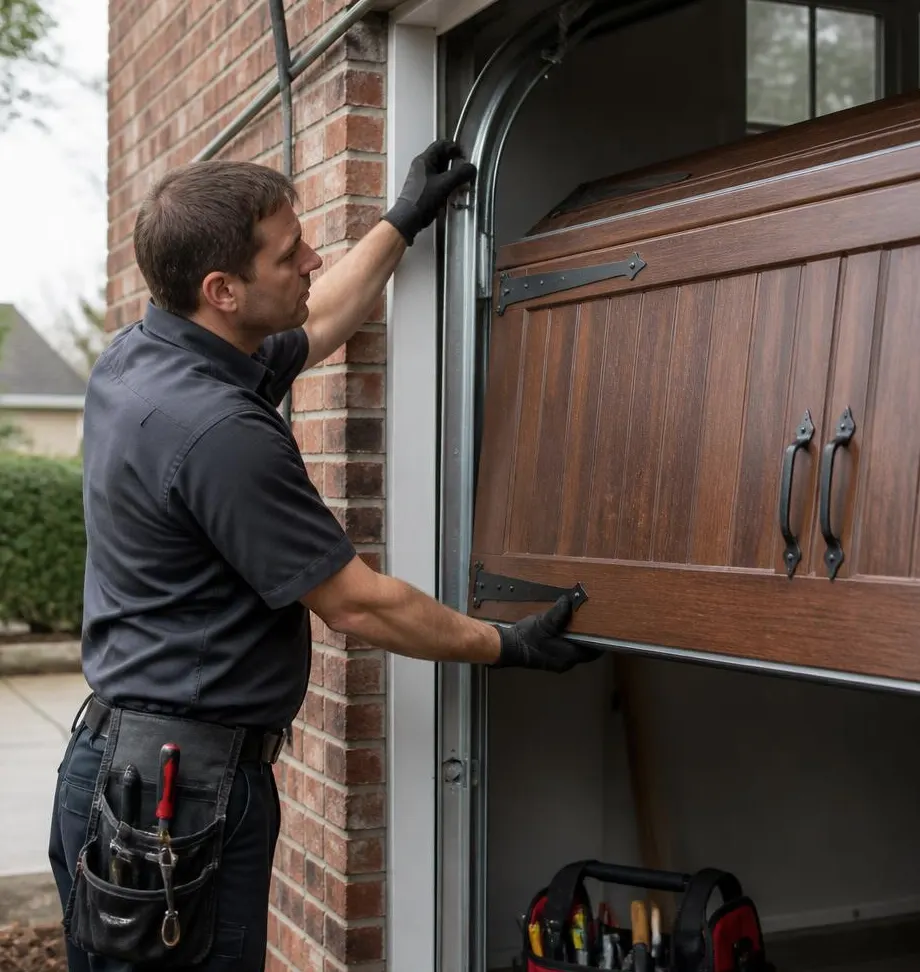
The Moment You Notice It
You pull into the driveway after a storm rolled through and there they are: little dimples across the bottom two panels of your garage door, the kind of dents that catch the evening light just right. Or maybe it's not hail at all — it's August, the door has baked in the sun for a decade, and now the wood trim along the bottom is cupping and the paint is cracking in long lines. Either way, you're standing in the driveway wondering if this door was ever built for this climate, and whether the replacement you pick next time will hold up any better.
That's really the question worth answering before you buy: not just steel vs. wood, but which material actually survives hot summers, sudden hail, steady wind, and blowing dust without turning into a maintenance project.
Steel
Steel is the standard for a reason. A quality steel door, especially a 24- or 25-gauge model with a polyurethane insulated core, holds up well against wind pressure and resists warping in heat because it's not organic material reacting to moisture. Hail is the real test: lighter-gauge steel doors can dent, but many manufacturers now offer impact-resistant panels built for hail-prone regions, and dents on steel are usually a cosmetic panel swap rather than a full door replacement. The one weak point is rust, which can start wherever the factory finish gets chipped by flying debris or a stray mower rock. Keeping the surface touched up prevents that from spreading.
Wood
Wood doors look great and can be custom-stained to match a home's trim, but this climate is tough on them. Long, hot summers dry and crack the wood, sudden humidity swings after storms make panels swell, and UV exposure fades stain faster than in milder climates. Wood also needs refinishing every couple of years to keep moisture out of the seams. It's a door for homeowners who genuinely enjoy that upkeep, not a low-maintenance choice.
Aluminum
Aluminum won't rust, which sounds appealing given Oklahoma humidity after storms, and it's lightweight, which is easy on openers and tracks. The trade-off is durability: aluminum dents far more easily than steel, and hail or wind-blown branches can leave marks that are hard to pop back out. It's a reasonable choice in drier, calmer climates, but it's not the strongest match for an area that gets sudden severe weather.
Fiberglass
Fiberglass resists denting better than aluminum and won't rot or rust, so it tolerates humidity and temperature swings reasonably well. Over many years of intense summer sun, though, fiberglass can become more brittle and prone to cracking on hard impact, which matters in a region where hail is a real possibility. It's a decent middle-tier option but not the toughest against impact.
Composite
Composite doors combine a wood-look exterior with a core that doesn't warp, rot, or need refinishing the way real wood does. They hold paint and stain well despite UV exposure and generally handle impact better than fiberglass or aluminum, closer to steel's resilience. The trade-off is cost — composite typically sits in a higher national price range than basic steel doors — but for homeowners who want the wood aesthetic without the wood maintenance, it's a strong fit for this climate.
Side-by-Side at a Glance
- Best hail/impact resistance: Steel (especially insulated, heavier-gauge) and composite
- Best for low maintenance: Steel and composite
- Best for custom curb appeal: Wood and composite (composite with far less upkeep)
- Most vulnerable to dents: Aluminum
- Most vulnerable to heat/humidity swings: Wood
- Best rust resistance: Aluminum and fiberglass
What We'd Recommend for Most Homes Here
For typical homes in and around Choctaw dealing with long hot summers, sudden hail and wind, and plenty of blowing dust, an insulated steel door is usually the most practical choice — it holds up structurally, the insulation helps with summer heat transfer into the garage, and repairs are usually straightforward. If the look of wood matters to you and you don't want the upkeep, composite is the next best option, offering similar resilience with better aesthetics at a higher price point. Aluminum and fiberglass can work but ask more trade-offs in exchange for their specific perks, and real wood is best reserved for homeowners genuinely committed to regular refinishing.
When to Call Choctaw Garage Door
If a recent storm left dents, your door is dragging from heat-swollen panels, or you're simply ready to replace an aging door with something built for this climate, that's exactly when to call us. We handle Garage Door Installation for homeowners choosing a new material, and Garage Door Repair for dents, panel damage, or hardware issues from wind and hail. We'll walk your garage, explain what's actually wrong, and recommend a material and door that fits your home and the weather it has to survive.
If your garage door in Choctoe, Midwest City, Del City, Nicoma Park, Harrah, Jones, Luther, or Spencer needs a second opinion, call Choctaw Garage Door today and we'll come take a look.